
• Manufacturers in the EV market are moving to incorporate the Plug and Charge technology, which they did not offer initially, in order to make them plug and charge compliant.
• Plug and charge technology helps the EV owner achieve a seamless EV charging experience that is focused on streamlining certain procedures, such as authentication and payments.
The world is moving towards the widespread deployment of public charging infrastructure to support the EV industry. The diverse range of authentication processes for EV charging leads to an unharmonized EV ecosystem and is expected to slow down the growth in the EV industry. But there are technological solutions available that radically improve the customer’s charging experience and renders it seamless; one such solution is the Plug and Charge technology.
Understanding the Plug and Charge Technology
Plug and Charge is the latest technology that allows drivers of electric vehicles to identify themselves safely and smoothly at the charging station, leading to an improved charging experience. Presently, the first step in charging an electrical vehicle is the identification of the EV driver, which can be done through a mobile application or with an RFID card. This is then followed by the plugging of the charger inside the EV.
EV owners usually have to register themselves with a wide range of Charge Point Operators (CPOs) and Mobility Service Providers (MSPs) when they plan on travelling long distances; therefore, they need to have several RFID cards or applications at the ready. These RFID cards or applications have their own PIN code that is required for the authentication process at different charging points, which can cause confusion regarding when to use which type of RFID card or mobile application. Additionally, RFID cards tend to, at times, not work at charging points which may frustrate the EV user. Furthermore, the payment procedure at charging stations is another hassle, where some chargers accept credit cards while others accept various other forms of payments. These reasons render the whole charging experience inconvenient for EV users.
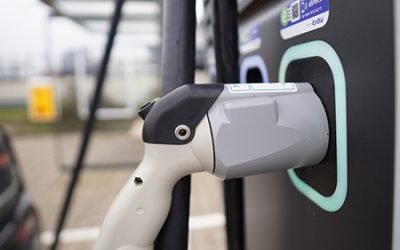
The Plug and Charge technology only requires users to plug the charging cable into the EV in order to charge their electric vehicle. As the cable is plugged in the EV, the vehicle is automatically identified by the charger and is authorized to withdraw energy to recharge the battery from the charging point. With the Plug and Charge technology in place, there is no need to enter credit card information, open a mobile application, scan a QR code, or take out easy-to-lose RFID cards.

Figure 1: Different protocols used in EV charging.
Source: MJBradley Interoperability Brief
Implementation of Plug and Charge
For nearly a decade, Tesla has been offering this Plug and Charge technology; other EVs such as Mustang Mach-E, the Lucid Air, and the Porsche also boast this feature. Manufacturers in the EV market are moving to incorporate the Plug and Charge technology, which they initially did not offer, in order to make them plug and charge compliant.
For example, EO Charging, a charging solutions provider based in the UK, filed a patent for ISO-15118 compliant EV chargers and software. This allowed EO to carry out smart AC charging of the legacy fleet of electric vehicles that were initially not equipped with the latest technology.
In the same vein, Hubject is offering Open Plug and Charge Protocol (OPCP), which allows free access to Plug and Charge. OPCP is the very first independent protocol which has standardized the Plug and Charge ecosystem.
Looking Ahead
According to Power Technology Research, the Plug and Charge technology has the capability to transform the charging experience of electric vehicle owners. It presents a significant opportunity to make use of the existing EV charging technology and is expected to increase the penetration of electric vehicles in the market. Plug and Charge technology helps EV owners achieve a seamless EV charging experience, focused on streamlining procedures such as authentication and payments.
EV Charging Infrastructure Service Overview
The research presented in this article is from PTR's EV Charging Infrastructure market research. For information about this service please submit a request shown below.
Contact Sales:
Europe
+49-89-12250950
Americas
+1 408-604-0522
Japan
+81-80-7808-1378
GCC/Rest of APAC
+971-58-1602441
More about our:
EV Charging Infrastructure Market Research
Recent Insights
EMEA EV Charger Market Outlook in 2020 and the Factors Driving it Further
Even though 2020 was a challenging year for most of industry sectors but EVSE (Electric Vehicle Supply Equipment) market in EMEA particularly in...

Plans and Incentives Driving the Major E-Mobility Markets
Global CO2 emissions dropped 5.8% in 2020 but are expected to increase again in 2021 according to IEA. Consumers worldwide are still reluctant to...

European Climate Law to be the Lifeline out of Pandemic
The pandemic shrunk the EU’s economy by 6.1% in 2020. The European Climate Law proposes a 55% reduction in net greenhouse gas emissions by 2030,...